
Romans
Part 02: The Righteousness of God
By: Craig Safar JR - May 21, 2026
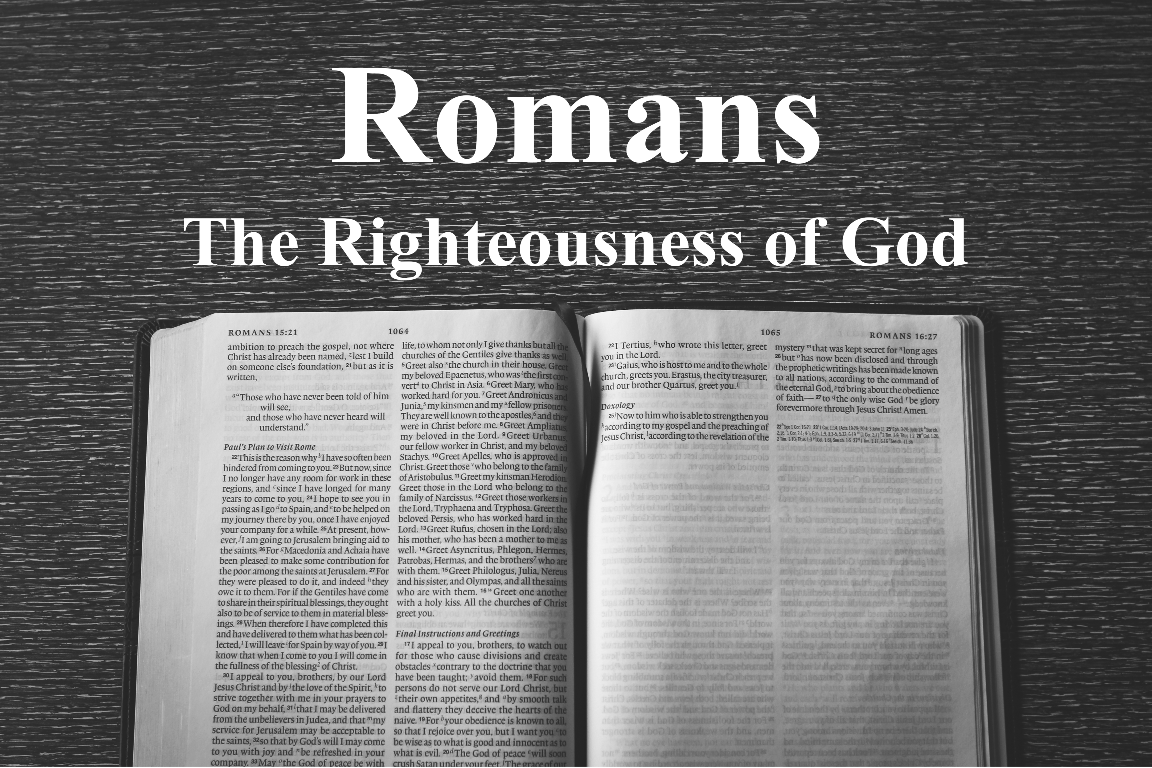
As we dive deeper into the book of Romans we will utilize the S.O.A.P. Bible study method. This will allow us to break down the passages into purposeful chunks and interact with the text in multiple ways.
Typically, you want to limit your study to short, continuous passages, but since we are looking at specific themes we are going to group several small passages together. This will hopefully build stronger Bible study skills as we push the S.O.A.P. method to do things it really wasn't meant to do.
I read Scripture in the CSB translation, used below, but feel free to use whatever translation you prefer. But, I commend studying in a translation that is not a paraphrase (such as the Message or NirV versions, the NLT is as far as I would go on translations that lean towards being a paraphrase but the Message might be useful in trying to understand certain passages). The reasoning is that if we plan to dive deeper into Scripture then it would make sense to use a translation that takes into account the original languages. Paraphrases do a good job at helping us understand what Scripture means for us today but removes this layer of study from us.
My overall recommendation is to choose up to three translations that are in the three main camps of translations: word-for-word or literal such as the ESV, Though-for-Though or dynamic equivalent such as the CSB, or Paraphrase such as the NLT (even though it branches into the Though-for-Thought camp). I found this resource that is a good visual guide on Bible translations and where the are placed in each camp: English Bible Translation Comparison.
If you are new to reading the Bible, the NLT is great as it was meant for younger readers to understand the greater overall message of the Bible. This comes in handy for adults too who are just starting out and don't know where to start or are getting hung up on more literal translations that can be harder to read.
Before we get into our study, make a note of what you think "The Righteousness of God" means or how it affects your life right now. This is a good practice to see if you have any presuppositions (an assumption that must be true) about the passage or topic being studied. It is important to leave room for God to work in you and provide His understanding (we call this illumination; specifically when the Holy Spirit helps direct us in understanding Scripture).
S - Scripture
Romans 1:16-17
16 For I am not ashamed of the gospel, because it is the power of God for salvation to everyone who believes, first to the Jew, and also to the Greek. 17 For in it the righteousness of God is revealed from faith to faith, just as it is written: The righteous will live by faith.
Romans 3:21-26
21 But now, apart from the law, the righteousness of God has been revealed, attested by the Law and the Prophets. 22 The righteousness of God is through faith in Jesus Christ to all who believe, since there is no distinction. 23 For all have sinned and fall short of the glory of God; 24 they are justified freely by his grace through the redemption that is in Christ Jesus. 25 God presented him as the mercy seat by his blood, through faith, to demonstrate his righteousness, because in his restraint God passed over the sins previously committed. 26 God presented him to demonstrate his righteousness at the present time, so that he would be just and justify the one who has faith in Jesus.
Read these passages at least 3 times and then pray over them asking God to open your heart and mind to allow Him to work in you to better understand His Word.
O - Observation
- Paul is not ashamed of the gospel and reflects on God's power to use the gospel for our salvation, which is for everyone who believes.
- What does belief mean though?
- Just as it is written means a callback to Scripture (usually the Old Testament), so does Habakkuk 2:4 say in reference to Romans 1:17?
- Righteousness is repeated several times.
- Righteousness comes from faith, so what is the role of faith?
- How is the law connected to this passage?
- If everyone sins, can we really be made righteous?
- What is the mercy seat?
- God passed over the sins, does this sound familiar? Is this related to the Passover event in the Old Testament
Remember, you are making your own observations here. I added an extended list of observations to give you an idea of what you might think of, please write down anything that pokes out at you, that you don't know, or any ideas or other themes you notice.
A - Application
- My faith is not something I should be ashamed of, rather, I should be expressing it wherever I can.
- Righteousness and salvation come by God through faith, therefore it is reassuring that since I can't earn it I also can't lose it.
- Since I cannot earn this, I don't need to try and prove myself to God or others because He is working in and through me and I am not leaning on my own strength, works, or understanding.
- God passing over the sins at first read sounds like it was pointing back to the Passover. In further study, this is actually compounded by the mention of the mercy seat and the main idea here with these two are that God chose to wait to pass judgment on our sins so that Jesus Christ would pay for them on the Cross, covering the mercy seat with His blood to atone for our sins (propitiation; the sins were NOT His but ours, but because of God's love for us He sent His Son to do this on our behalf - John 3:16).
- By putting our faith in Jesus and His redemptive work on the cross to pay for our sins, we are made righteous before God (Justification).
- God has provided us the ultimate example of grace (giving someone something they don't deserve), therefore, we are to extend this type of grace to others (I know, this can and is hard to do, but anything can be done through Christ who strengthens us - Philippians 4:13).
In between Observation and Application is where you will do deeper studying. Check your Bible for any cross-references in the passage(s) and then read those as well. If you have a study Bible it may provides some notes on particular sections to help connect or explain what is going on, and a commentary will go even further. There are some good online resources as well such as Blue Letter Bible and Scripture Tools for Every Person.
P - Prayer
Lord,
Thank You for freely giving us the gift of salvation and providing the way to be righteous before You through sending Your Son Jesus Christ to die on the cross and pay for our sins. This was only something You could do and gives me assurance that I can never be taken from You. I pray that You give me boldness to live out my faith and share it with others and to never be ashamed in putting my faith in You.
Amen.